
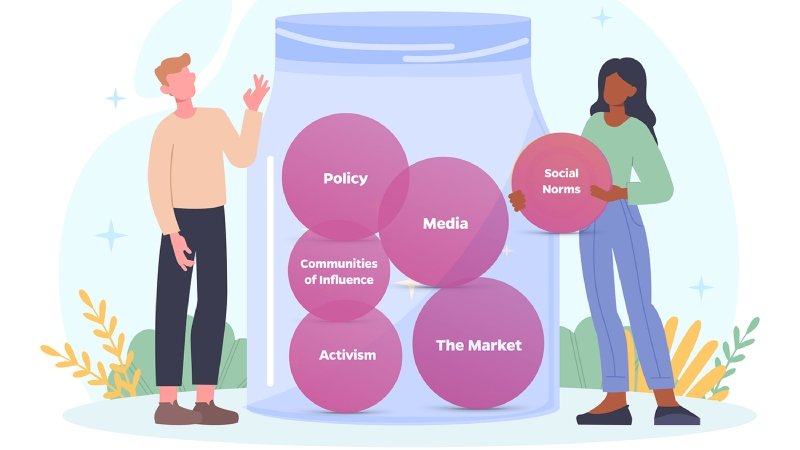
Most campaigns don’t fail because people don’t care. They fail because they push in the wrong direction. Many focus only on what feels familiar usually media or policy and ignore other important areas. The Six Spheres of Influence framework, created by the Center for Public Interest Communications at the University of Florida, helps changemakers see the bigger picture.
It gives a clear way to understand a social issue and find where real impact is possible. The idea is simple: real change rarely comes from just one approach. Strong campaigns work across six key areas policy, media, communities of influence, market and industry, activism, and social norms. The real question is not which sphere is most important.
It’s about finding which ones are easiest to reach, most promising, and most likely to create momentum. That depends on your issue, your resources, and the timing.
The science behind it
The Six Spheres of Influence is based on systems thinking. This idea helps us find the root causes of problems instead of just fixing surface issues. It also helps us see new opportunities for change. Systems thinkers don’t look at problems in isolation. They focus on the whole system and how different parts connect. A common idea in systems thinking is: every system creates the results it is designed for. So, if you want to change an outcome, you first need to understand how the system works.
Each sphere in the framework is backed by research. For example, the media sphere is linked to agenda-setting theory. This shows that media doesn’t just shape opinions it shapes what people think about. The social norms sphere is also important. Research shows that people often follow what they believe others like them are doing. Their behavior is strongly influenced by these perceptions. This framework turns these insights into simple, practical questions to guide better strategies.
The Six Spheres of Influence
Policy: This includes laws and rules made by governments or organizations. It’s a common focus for change, but rules alone don’t change behavior. If people don’t support or follow them, they won’t work. For example, texting while driving is illegal in many places, yet people still do it.
Media: Media is not just news. It includes social media, ads, entertainment, sports, and more. It shapes how people see the world and what they care about. It also influences identity and values. Understanding media means knowing which stories and ideas are already shaping people’s views.
Communities of Influence: These are groups or people who shape opinions. They include experts, organizations, influencers, and leaders. Every issue has many voices, and they often disagree. For example, different groups may push very different solutions to the same problem.
Market and Industry: Businesses and industries play a big role in social issues. Their decisions can send strong messages. When a company takes a stand, it can influence public opinion and behavior, not just its own business.
Activism: Activism is organized effort to push for change. It puts pressure on powerful systems like governments or companies. It also shows that people care and creates urgency.
Social Norms: People often follow what they think others like them are doing. This need to fit in shapes behavior. Campaigns work best when they highlight positive behaviors. If messaging is done wrong, it can actually make bad behavior seem normal.
These spheres give public interest communicators a way of thinking about the different levers they can pull to drive change and how they interact and intersect.
How the spheres interact: the Montgomery Bus Boycott
The real power of this framework is not in each sphere alone, but in how they connect. Action in one area creates impact in others. No strong campaign works in just one sphere. The Montgomery Bus Boycott is a clear example. Leaders like Jo Ann Robinson organized people and built strong community networks. This led to sustained activism a bus boycott that created financial pressure on National City Lines.
The protest gained global media attention and strengthened social norms within the Black community, encouraging unity and participation. All of this pushed toward one goal: policy change. It came when the U.S. Supreme Court ruled bus segregation unconstitutional under the Fourteenth Amendment. The key lesson is simple: use the spheres where you have power, then create pressure in the ones where you don’t.
Identifying your resources
People who care deeply about a cause often aim too high without matching their resources. Real impact starts with clarity and honesty about what you actually have. Resource mobilization theory highlights five key resources: money and materials, people and skills, strong networks, cultural insight, and credibility or trust. These shape what you can realistically achieve.
Ask yourself: What is your budget? How flexible is it? Who is on your team, and what can they do well? What relationships and trust have you built? Which groups can you partner with?
When you map these resources across the six spheres, you start to see hidden strengths and new opportunities. That’s where smarter, more effective strategy begins.
For any suggestion, or changes, please contact us, the Influence Gone Wild team.