
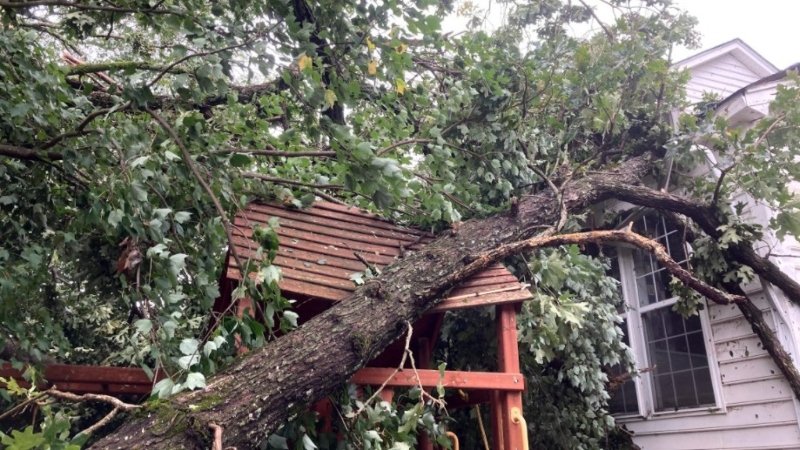
You’re sitting there, tea in hand, admiring how the afternoon sun hits the mature Oak at the end of your garden.
It’s the reason you bought the place. But then you notice a subtle lean that wasn’t there last June, and you start wondering if that ‘rustic’ hollow in the trunk is a feature or a structural disaster waiting for a gust of wind.
So, instead of crossing your fingers every time the weather turns, it’s time to take a closer look at the problem. Keep reading to find out if your garden’s centrepiece is secretly planning a relocation.
1.Ash
Ash trees haven’t exactly had an easy run lately, and things aren’t looking much better.
Since it was first confirmed in the UK back in 2012, ash dieback, caused by the fungus Hymenoscyphus fraxineus, has been spreading steadily.
It works its way through the tree’s system, blocking the flow of water and nutrients until branches start to die back, which is exactly where the name comes from.
The real issue is how quickly things can go downhill. A tree that looked perfectly healthy last summer can turn unstable within a single season. And once ash wood dies, it becomes surprisingly brittle, so the whole tree can end up falling without warning.
If you’ve got an ash tree near your home or along a footpath, it’s worth having someone take a look sooner rather than later.
2.Willow
Willows are beautiful, fast-growing, and constantly on the hunt for water, which is exactly where the trouble starts.
Their root systems are aggressive and wide-ranging, drawn instinctively towards the moisture in drains, pipes, and building foundations. So, the damage can end up affecting the stability of both the tree and the surrounding ground.
They also shoot up quickly, which sounds great until you realise fast growth usually means weaker wood. The branches can split under their own weight, especially after a stretch of wet or windy weather.
If you’re picturing that Instagram-perfect weeping willow by the water, just keep in mind that these trees are the opposite of low-maintenance.
3. Poplar
Poplar trees are tall, narrow, and often planted in rows as windbreaks. It’s a bit ironic, though, given how poorly they cope with wind.
The issue comes down to their roots. For trees that grow that tall, their root systems are relatively shallow, which makes them far more likely to topple in a storm. And when a poplar goes over, it usually lifts the entire root plate out of the ground, leaving behind a crater.
Like willows, they’re also relentless when it comes to chasing water. If you’ve got drains, pipes, or anything underground nearby, they’ll head straight for it, often causing damage along the way.
As they get older, internal decay can set in as well. Pair a hollowing trunk with a shallow root system, and you’ve got a tree that’s a lot less stable than it looks.
4. Birch
Silver birch is one of the UK’s most graceful native trees, and one of its shorter-lived ones.
Most birch trees don’t make it much past 80 to 90 years before they start to decline structurally. As they age, they become more vulnerable to fungal infections, especially bracket fungi, which settle into the trunk and slowly break the wood down from the inside.
Their slender trunks don’t help, either. After storm damage or any kind of physical knock, weaknesses can develop fairly quickly.
And unlike some tougher species, birch isn’t great at sealing off wounds, so once the bark is breached, decay tends to spread more easily.
5. Oak
Oak might be Britain’s most beloved tree, but ‘beloved’ doesn’t mean ‘bulletproof.’
They live for a long time, which sounds great until you realise the problems that come with that. Older oaks often develop serious internal decay that you won’t spot from the outside. Your tree can still look impressive and full of life, all while hollowing out beneath the surface.
Then there’s the sudden branch drop. Large, healthy-looking limbs can come down without warning, usually during hot, dry spells in summer. Nobody fully understands why it happens, which makes it especially tricky to predict.
Oaks can also be affected by acute oak decline and fungal infections that gradually weaken the roots. Remember, these are massive trees, so if something gives, it can cause property damage on a large scale.
6.Elm
Elm was once one of the most common trees in the British countryside. Then, Dutch elm disease arrived, and the landscape changed almost overnight.
The disease, spread by bark beetles carrying a lethal fungus, killed millions of trees across the UK during the 1970s. Today, elm trees that managed to survive or regenerate are still at risk, as the disease is still circulating.
If an elm does become infected, things tend to go downhill quickly. The tree deteriorates fast, and the wood becomes brittle not long after it dies. That’s where the real risk comes in; dead or declining elms can drop large limbs without much warning.
7.Horse Chestnut
If you grew up in the UK, you’ll likely remember horse chestnuts for their conkers, sticky buds, and the white ‘candles’ that appear every spring.
Unfortunately, they’ve been having a tough time. Bleeding canker, a bacterial disease, has been affecting horse chestnuts across the UK for years. It causes dark, sticky lesions on the bark, and in severe cases, it can effectively choke the tree by girdling the trunk.
They’re also prone to leaf miner moth infestations. On its own, it’s more of a slow drain than an immediate threat, but it weakens the tree over time and leaves it more exposed to bigger problems.
8.Linden
You’ll often see linden trees lining parks, avenues, and larger gardens, and it’s easy to see why. They’re attractive, long-lived, and generally low-maintenance. That said, they do have a few structural quirks that you should know about.
Linden trees often develop co-dominant stems, where two or more main trunks rise from the same base. If that’s left unmanaged, it can form what’s called an ‘included bark union,’ which is essentially a weak point built into the structure.
If you’ve got a linden, a professional tree surgery expert can pick up on this kind of issue early, before it turns into something more serious. If it’s spotted on time, a reduction cut or support system is often enough to keep the tree stable.
Conclusion
You don’t need to start wearing a hard hat every time you walk into your garden. But you definitely don’t want to be the person who ignores a crack in the trunk only for your whole tree to end up in your neighbour’s kitchen.
So, do yourself and your roof a massive favour: bring in an expert to take a look, tick it off your list, and go back to enjoying your garden in peace.